
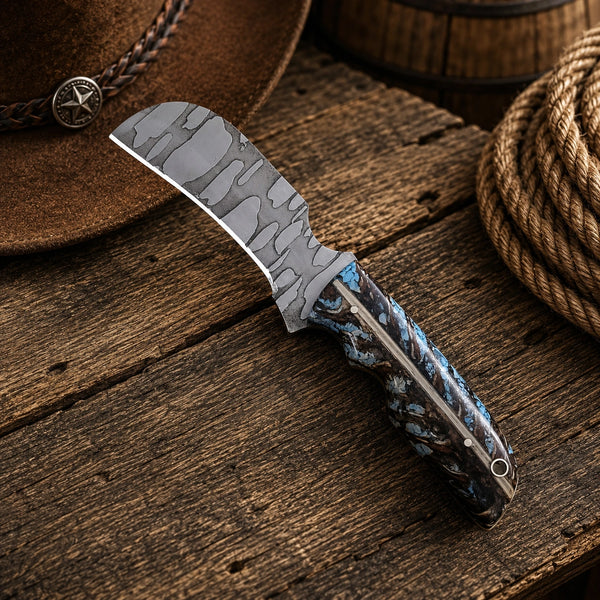


Turquoise Handle Hunting Knife | Acid Etched Full Tang Blade
Shipping calculated at checkout
Low stock
Description
A handmade full tang hunting knife with a 4 inch high carbon blade in a cloud acid-etch finish, contoured crushed turquoise resin scales, an exposed polished spine running the length of the handle, and a lanyard tube at the butt.
What Is the Cloud Finish on the Blade?
Not Damascus, and worth saying so up front because the mottling gets mistaken for it. Damascus gets its pattern from forge-welding two steels together and etching to reveal the layers. What you see here is a single piece of high carbon steel that has been etched to break the surface into irregular dark and bright fields, then hand-worked back so the raised areas take a polish and the recessed ones stay dark.
The practical effect is the same reason a stonewash works on a working knife. A broken surface hides scratches, fingerprints, and field wear far better than a mirror polish does, and the oxide in the darkened areas slows surface rust slightly. Every blade etches differently, since the pattern depends on how the acid moves across that particular piece of steel, so no two come out matching. For the comparison against layered steel, read our guide on real versus fake Damascus.
Why Is the Tang Exposed Along the Spine?
The bright line running the length of the handle is the steel itself, not an inlay. Full tang means the blade stock continues unbroken to the butt, and on the Thunderhead the scales are fitted either side of it while the spine is left proud and polished flush.
Three things follow. The knife takes lateral load and pommel work without anything to separate or crack, since there is no joint along the spine to fail. You can strike the exposed spine with a baton or the heel of your hand for controlled splitting. And you can see the construction rather than taking our word for it, which matters more than it sounds on a knife sold online.
The honest cost is cold. Exposed steel against your palm in November is unpleasant, which is exactly why our hidden tang builds exist. If you hunt late season in hard cold, the hidden tang Ridgeback gives you the same strength with wood between your hand and the steel.
What Is the Crushed Turquoise Handle Made Of?
Turquoise chips crushed and suspended in black resin with copper flake, cast under pressure into a block, then cut and shaped into scales. Different material from the pine cone resin across our cowboy line, and different again from the solid stone composite on the Prairie Rose.
Crushed stone behaves better in a handle than solid stone does. Solid slabs carry the fracture planes of the original material and will split along them under a hard knock. Chips suspended in resin have no continuous plane to fail along, so the resin absorbs the shock and distributes it. Trading a solid face for a chip pattern buys you a genuinely tougher handle.
The scales are contoured rather than flat, which is worth noticing on the price. Most handmade knives at this size run flat slab scales because contouring means shaping each side by hand after the block is pinned, then re-finishing the whole surface. The palm swell and finger grooves here are ground in individually.
Honest limitations: resin softens in sustained heat, so keep it off a dashboard in summer, and acetone or abrasive cleaner will dull the polish. Expect variation between knives in chip density, how much copper catches the light, and how the pattern falls across the contours. Compare it against the other handle materials in our hunting knives range.
Technical Specifications
| Specification | Details |
|---|---|
| Product type | Handmade fixed-blade hunting knife |
| Overall length | 8.5 inches |
| Blade length | 4 inches |
| Handle length | 4.5 inches |
| Blade material | High carbon steel |
| Blade hardness | 58–60 HRC |
| Blade style | Drop point with swedge, deep belly |
| Finish | Cloud acid etch, hand-polished highs |
| Guard | Stepped choil at the ricasso, no separate guard |
| Handle material | Crushed turquoise in black resin with copper flake, contoured |
| Tang construction | Full tang with exposed polished spine |
| Fittings | Two nickel-silver pins, lanyard tube |
| Sheath | [confirm before publishing] |
| Engraving | Optional blade personalization, $20 CAD |
Why No Guard?
The step cut into the underside where the blade meets the handle does the guard's job. Your index finger seats into that corner and the shoulder of the ricasso stops it travelling forward onto the edge, which is all a guard is for on a knife this size.
Leaving the guard off buys you two things. The blade can be choked all the way up for detail work, since nothing sits between your hand and the cutting edge, and the whole knife slides in and out of a sheath cleanly with no crossbar to catch. The trade is that a hard forward thrust into resistance relies on your grip rather than a physical stop, which is one more reason a knife this size is a cutter rather than a piercer.
Which Tasks Suit This Knife?
Hunting first. The deep belly through the forward half of the blade is what skinning wants, giving you a long sweeping contact patch to separate hide from meat, while the drop point keeps enough tip control for caping and detail work around the head and legs.
Beyond that it makes a genuinely capable general fixed blade. Camp food prep, cord and rope, packaging, light wood work, and controlled splitting with a baton on the exposed spine. Four inches of high carbon at working hardness covers a lot of ground.
Understand the limits. Not a chopper, not a pry bar, and high carbon at 58 to 60 HRC will chip rather than roll if you drive it into bone. Heavy wood processing belongs to a thicker blade from our bushcraft knives range.
Honest Note on Who Should Buy This One
The Thunderhead is the most versatile knife we make at this size, and the reason is that nothing about it is specialised. No gut hook, no guard, no exotic geometry. A drop point with good belly, a tough handle, and a tang you can hit.
If you want one knife to take hunting and then keep using year round, this is the one to take. If you want the layered pattern that makes people ask about the blade, a Damascus hunting knife gives you that for similar money and the same working performance. If you hunt in serious cold, take a hidden tang instead so your palm is not on bare steel.
How Should You Care for the Blade and Handle?
High carbon with no chromium, so moisture is the only real enemy, and the etched finish slows corrosion rather than preventing it.
- Wipe the blade down after every use, especially after blood, salt, sap, or anything acidic.
- Wash by hand with mild soap, warm water, and a soft cloth. Never a dishwasher.
- Dry the blade, spine, and handle fully and immediately, paying attention to the seam where the scales meet the tang.
- Apply a thin coat of food-safe mineral oil or knife oil before storage.
- Store dry, and out of any sheath long term, since leather holds moisture against steel.
The etched finish darkens further with use, which is normal and is doing a small amount of protective work. Orange spotting is a different thing and comes off with oil and a non-scratch pad. The resin scales need nothing at all, no oiling and no conditioning. When the edge dulls, high carbon takes a keen edge back on a plain stone in a few passes, and our knife sharpening guide covers the angle.
Can You Personalize It?
Yes. Custom engraving is $20 CAD, added at checkout, with your text entered in the engraving instructions field. Names, initials, dates, and short lines all work, up to roughly 20 characters. Worth knowing that engraving reads differently on an etched blade than on a polished one, since the cut breaks through the darkened surface into bright steel underneath, which most people prefer. For a different resin colour or a hidden tang version, get in touch through our custom knife request form.
Made by Hand in Canada
Stag Steel Knives has been forging since 2001, and every blade is ground, heat-treated, etched, and finished by hand in our New Brunswick shop, with the scales cut, pinned, contoured, and polished individually. Free shipping across Canada and the United States. Compare the Thunderhead against the rest of the range in our skinning knives and D2 steel hunting knives collections.

