
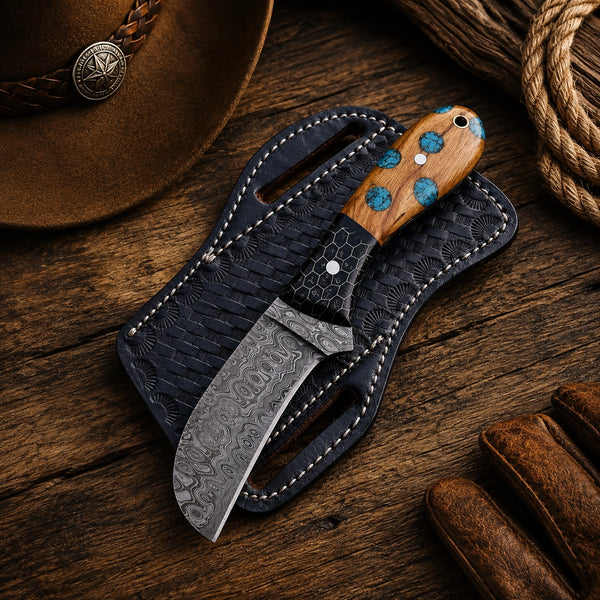


Hawkbill Curved Knife | Damascus Blade, Cholla Cactus
Shipping calculated at checkout
Low stock
Description
A handmade Western skinning knife with a 7.5 inch overall length, a 3.5 inch hand-forged raindrop Damascus curved blade, a hardwood handle set with Cholla Cactus , a black honeycomb resin bolster, and a hand-tooled basketweave pancake sheath.
Curved Blade, but Not a Hawkbill
Two very different knives get sold as curved, and confusing them costs people money.
A hawkbill drops the tip below the handle line and runs a concave edge, so the blade hooks around a rope or a cable and does its cutting on the pull stroke. Linemen use the shape to score and strip insulation without nicking the conductor beneath, and gardeners use the same geometry for pruning. The hook is the entire point, because it stops the blade skating off a round surface.
The Mesa Verde curves the other way. The edge is convex and swept, built to stretch across a hide and take it off in long strokes rather than hook into something and pull. Both blades are curved, and they are built for opposing motions. For the hooked profile, see our handmade hawkbill knives collection.
Why a Curved Edge Skins Better Than a Straight One
Belly is what does the work. Separating hide from meat is a sweeping motion, and the longer the curve of the edge, the more of it stays in contact through that sweep. More contact means fewer strokes, less sawing, and less chance of pushing through the membrane underneath into the meat.
A straight edge, like the sheepsfoot on a bull cutter, gives you flat push cuts and easy sharpening, and it is the wrong tool the moment you are following a contour. The Mesa Verde trades the flat section away entirely to get the deepest belly we grind at this size. Compare it against the drop points in our skinning knives range.
What Damascus Pattern Is on the Blade?
Hand-forged 15N20 and 1095, hardened to 58 to 60 HRC, worked into a raindrop pattern rather than the flowing wave that runs through most of our line. Raindrop comes from drilling or punching dimples into the surface of the billet before the final flattening, which pulls the layers underneath into concentric rings that surface as rounded pools once the blade is ground and etched.
The effect reads busier and more three-dimensional than a random wave, and a curved blade gives the pools more room to spread across the belly than a straight profile would. Every billet is dimpled by hand, so ring spacing and depth vary blade to blade. For the background on how the layers form, read our guide on how Damascus steel is made.
Technical Specifications
| Specification | Details |
|---|---|
| Product type | Handmade fixed-blade curved skinning knife |
| Overall length | 7.5 inches |
| Blade length | 3.5 inches |
| Handle length | 4 inches |
| Blade material | Hand-forged 15N20/1095 Damascus |
| Blade hardness | 58–60 HRC |
| Blade style | Curved skinner, deep convex belly, raindrop pattern, etched finish |
| Bolster | Black honeycomb resin, pinned |
| Handle material | Cholla Cactus wood |
| Fittings | Nickel-silver pins, brass-lined lanyard eyelet |
| Tang construction | Full tang |
| Sheath | Black leather pancake, basketweave centre with sunburst border |
| Carry | Two belt slots, crossdraw angle |
| Engraving | Optional blade personalization, $20 CAD |
What Is the Honeycomb Bolster For?
Set between the blade and the wood, the black honeycomb section is cast resin with a white cell structure through it, cut and pinned as its own piece rather than being part of the scales. Functionally it seals the joint where steel meets wood and keeps moisture out of the end grain, which is where a wooden handle fails first.
Visually it does the job a brass bolster does on our cowboy knives. The raindrop steel is busy and the turquoise handle is busy, and a block of black between them stops either one shouting over the other.
How Does the Pancake Sheath Carry?
A pancake is two panels of leather stitched around a welt with belt slots cut through both, so the sheath lies flat against the hip rather than hanging off it. Riding flat keeps the knife out of the way when seated or mounted and stops it swinging as you walk. Retention comes from the moulded fit rather than a strap, so the draw is clean one-handed, which matters when the other hand is holding an animal.
The face is worked in a diagonal basketweave through the centre panel, framed with a sunburst border, dyed black with contrast cream saddle stitching. Basketweave is the traditional Western stamp, the same one running across saddle and tack leather, worked a single impression at a time over damp vegetable-tanned hide before dyeing. Every panel is stamped by hand, so the weave will not align identically across two sheaths.
Which Tasks Suit This Knife?
Skinning and caping first, which is what the curve exists for. Hide removal on deer-sized game, close work around the head and legs where control beats reach, and the general run of camp cutting on cord, food, and packaging.
Understand the limits. A swept tip is fine and unsupported, so it will snap if you pry with it or drive it into bone, and there is no flat section for push cuts against a board. Batoning and heavy camp work belong to a thicker blade from our bushcraft knives range. Cable, wire, and insulation work belong to a hawkbill, which this is not.
Honest Note on Who Should Buy This One
The Mesa Verde is a dress skinner. Real working geometry, finished as a piece you will be pleased to hand across a truck bed. If the knife is going to live in a pack and get used hard every season, the turquoise inlay is money spent on something that can chip, and a resin or micarta handle in the same size takes more abuse for less.
One more thing worth being direct about. If you arrived looking for a hawkbill to strip cable or prune with, the geometry here is wrong for both jobs and no amount of description will change that. Take the Mesa Verde if you skin game, if you collect Western knives, or if you want a genuinely capable skinner that happens to be beautiful.
How Should You Care for the Blade, Wood, and Stone?
Damascus is high-carbon and reacts to moisture faster than stainless, and three handle materials each want slightly different attention.
- Wipe the blade down after every use, especially after blood, salt, or acidic food.
- Wash by hand with mild soap, warm water, and a soft cloth. Never a dishwasher.
- Dry the blade, bolster, and handle fully and immediately.
- Apply a thin coat of food-safe mineral oil or knife oil to the blade before storage.
- Store dry and out of the sheath long term, since leather holds moisture against steel.
The hardwood benefits from a wipe of mineral oil once or twice a year, which keeps the grain fed and protects the seating around the inlays. The turquoise needs nothing beyond staying clear of solvents and abrasives, and the resin bolster needs nothing at all. A grey patina on the steel is normal and mildly protective, while orange spotting comes off with oil and a non-scratch pad. When the edge dulls, work the belly in sections rather than trying to hold the whole curve flat on the stone, and our knife sharpening guide covers the angle.
Can You Personalize It?
Yes. Custom engraving is $20 CAD, added at checkout, with your text entered in the engraving instructions field. On a 3.5 inch blade the practical limit is about 15 characters, so initials, a date, or a ranch brand work better than a full sentence. For a different inlay stone or alternate sheath tooling, get in touch through our custom knife request form.
Made by Hand in Canada
Stag Steel Knives has been forging since 2001, and every blade is drawn out, ground, heat-treated, and finished by hand in our New Brunswick shop, with the inlays seated and the leather cut, stamped, dyed, and stitched in-house to fit each individual knife. Free shipping across Canada and the United States. Compare the Mesa Verde against the rest of the range in our Damascus hunting knives and buckaroo knives collections.

