
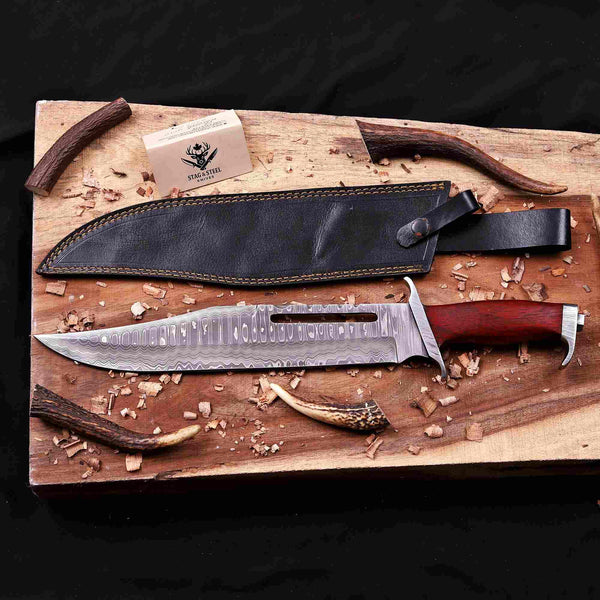


Rambo III Damascus Bowie Knife – Pakka Wood Handle
Shipping calculated at checkout
Low stock
Description
Rambo III Bowie Knife, Forged by Hand
Let's be honest — most Rambo III Bowie Knife" knives out there are factory stampings with a movie name slapped on. This isn't that. We forge this one by hand, one at a time, the way a big bowie like this is supposed to be made. You get a 12-inch VG10 stainless Damascus blade, a Damascus guard and pommel, a red pakka wood handle that fills your palm, and a leather sheath that's actually stitched, not glued.
It's a serious piece of steel. At about 650 grams with a 5mm spine, it has real weight and presence. Pick it up and you'll feel it straight away — this is a knife built to be used, carried, and handed down, not left in a drawer. If you're new to big blades like this, it's worth browsing our full range of handmade bowie knives to see how this one stacks up against the rest of the lineup.
Why VG10 Stainless Damascus Matters
Here's where this Rambo III knife pulls ahead of most Damascus bowies you'll find. A lot of Damascus out there is high-carbon steel. It looks great, but it rusts the moment you forget to oil it. Leave it in a humid garage for a week and you'll find spots.
Ours is different. We use VG10 paired with 15N20, which makes a stainless Damascus. You still get the hardness and the rippling pattern, but the blade fights off rust far better than ordinary carbon Damascus. For a knife this size — one you'll probably take outdoors — that matters. You spend less time babying it and more time using it. This knife sits in our Damascus bowie knives collection, which is where you'll find our most eye-catching pattern-welded blades.
The 15N20 brings the nickel that makes the pattern pop. The VG10 brings the edge that holds. Together they give you a blade that performs and a blade that turns heads. Every one comes out a little different, so the pattern on yours won't match anyone else's.
The Heat Treatment — and Why the Spine Is Softer
This is the part most sellers skip over, so pay attention because it's the difference between a knife that lasts and one that snaps.
We heat treat this blade differentially. That means the hardness isn't the same everywhere. The cutting edge is taken up to 59 to 61 HRC — hard, so it takes a sharp edge and keeps it through real work. The spine, though, we keep softer, around 55 to 57 HRC.
Why on purpose make part of the knife softer? Because a blade that's hard all the way through is brittle. Hard steel is strong but it doesn't bend — it cracks. If your whole spine sits at 60+ HRC and you put it under heavy stress, prying or batoning or just a hard impact, there's a real chance it lets go and breaks.
By keeping the spine in that 55–57 range, we leave it some give. The edge stays hard where you want sharpness. The spine stays tough where you want the knife to flex and absorb shock instead of shattering. It's old-school bladesmithing, and it's the reason a properly heat-treated knife can take abuse a uniformly-hardened one can't. So if you ever feel like the spine has a touch of flex to it — that's not a flaw. That's the knife doing exactly what it's built to do.
How This Knife Is Built
Construction is simple to describe and hard to do right. This is a full-tang Damascus Rambo III knife. The steel runs in one continuous piece from the tip all the way through the handle to the pommel. There's no welded joint hiding under the scales, no thin rat-tail tang waiting to wobble loose. One piece of steel, top to bottom. That's where the strength comes from.
The guard and pommel are forged from Damascus too, fitted by hand so the lines stay clean. The handle is pakka wood — if you haven't handled it before, it's a dense wood that's been resin-stabilized, so it shrugs off moisture in a way plain wood can't. We shape it to fill the hand and give you a grip that stays put even when your hands are wet or cold. The deep red color isn't dyed-on; it runs through the material.
Then the whole blade gets etched to bring the Damascus pattern to the surface. That's the step that takes a finished-but-plain blade and makes it the thing people stop and stare at.
What You'd Actually Use It For
This is a big bowie, so let's be real about it. It's not a little EDC folder. It's the knife you reach for when you want presence and capability — hunting trips, camp work, chopping and clearing, field tasks where a smaller blade just won't do. The size that makes it impractical for slipping in a pocket is exactly what makes it shine for bigger jobs.
And plenty of people buy it purely as a collector's piece, and that's fair too. A hand-forged Damascus bowie this size, with the Rambo III lines, looks incredible on display. If you like knives with a story behind them, take a look at our Crocodile Dundee bowie knife — another iconic big-blade design that collectors love for the same reasons. The good news is you don't have to choose. This one's fully functional and collector-grade at the same time. Use it, display it, or both.
A Genuinely Good Gift
If you're shopping for someone who's hard to buy for — a hunter, an outdoorsman, a collector, the guy who already has everything — this lands every time. It's the kind of gift that gets remembered. Father's Day, a milestone birthday, an anniversary, groomsmen gifts, a retirement. We can engrave it too, so it becomes truly theirs. Just reach out before you order and we'll sort the details.
Every order also ships with a free embroidered Stag Steel Knives cap. Small thing, but it's our way of saying thanks.
Specifications
- Style: Sawback Bowie Knife, full tang
- Blade Steel: VG10 / 15N20 Stainless Damascus
- Edge Hardness: 59–61 HRC
- Spine Hardness: 55–57 HRC (differential heat treat)
- Blade Length: 12 inches
- Blade Thickness: 5mm
- Handle: Pakka Wood, 5.25 inches
- Guard & Pommel: Damascus Steel
- Weight: approx. 650g
- Sheath: Handmade black cowhide leather
Taking Care of It
Not complicated, just don't ignore it. Wipe the blade down and dry it after you use it. Every so often, rub on a light coat of oil — mineral oil or camellia oil both work fine. Don't store it long-term inside the leather sheath, because leather can trap moisture against the steel. Keep it clean, keep it dry, keep it lightly oiled, and this knife will still be sharp and good-looking long after you've passed it on to someone else. If you want the full rundown, our guide on how to care for a Damascus knife walks through everything step by step.
Why Buy From Stag Steel Knives
Every knife we make is forged by hand in small batches — no factory line, no mass production. We've been making knives since 2001, and we stand behind every blade that leaves the shop. If something isn't right when it reaches you, tell us and we'll make it right. Simple as that.

