
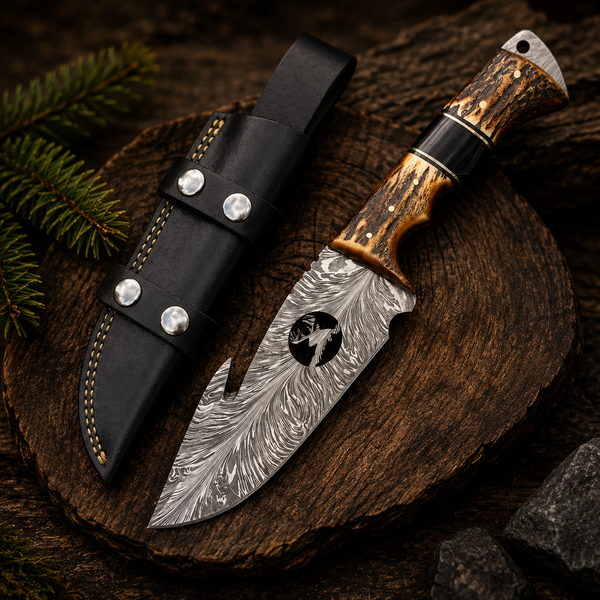


Feather Damascus Gut Hook Knife with Stag Horn Handle
Shipping calculated at checkout
Low stock
Description
A handmade gut hook hunting knife featuring a 4.5-inch feather-pattern Damascus blade with a wire-cutting notch and buck silhouette cutout, a stag horn handle with a horn spacer and brass liners, and a studded leather sheath.
What Makes This Feather Damascus Blade Different?
Our Feather Damascus Gut Hook Hunting Knife carries a distinctive forging pattern that sets it apart from the standard wavy Damascus used across the rest of our gut hook lineup. Instead of the usual random layering, a feather Damascus billet is split lengthwise down the center and welded back together, so the pattern fans outward from a central line like the curve of a bird's feather, rather than running in loose waves.
At 9 inches overall with a 4.5-inch blade, it's built for field dressing with a bit more reach than our compact 8-inch gut hook models.
Browse similar working blades in our Gut Hook Knives collection.
How Do the Gut Hook and Wire Notch Work Together?
The gut hook on the spine lets a hunter open the hide along the belly in one controlled pull, keeping the cut shallow and lowering the risk of nicking the stomach or intestines. The wire notch sits just below it and gives a dedicated edge for cutting wire, rope, or fencing, the same working idea used on our Bull Cutter Knives, so the main edge stays reserved for skinning and finer work.
What Is the Buck Medallion Cutout on the Blade?
A circular medallion is cut directly into the blade face, carrying a buck silhouette. It's a decorative detail on an otherwise working blade and doesn't affect the gut hook, wire notch, or main cutting edge.
Technical Specifications
| Specification | Details |
|---|---|
| Product type | Handmade fixed-blade gut hook hunting knife |
| Overall length | 9 inches |
| Blade length | 4.5 inches |
| Blade material | Feather-pattern Damascus steel (15N20/1095) |
| Blade hardness | 56–58 HRC |
| Blade style | Gut hook with wire-cutting notch and buck medallion cutout |
| Handle material | Natural stag horn with horn spacer and brass liners |
| Tang construction | Full tang |
| Included accessory | Studded leather sheath |
| Custom engraving | Available — name, logo, or message |
Why Choose a Stag Horn Handle for This Knife?
Stag horn is a traditional choice for field and skinning knives, valued for a naturally textured surface that grips well even when hands are wet or bloody from field dressing. On this knife, the horn scales are set off by a dark horn spacer and brass liners at the guard, adding contrast against the mottled natural coloring of the handle.
Being a natural material, its color and grain vary from piece to piece, so no two handles look exactly alike. It also contains natural moisture and can dry out or crack over time if neglected, so a light oiling once or twice a year helps keep it stable.
Common variations across stag horn handles include:
- Surface texture and mottling
- Natural coloring, from pale cream to darker weathered tones
- Grain density along the handle
These are natural characteristics and not a defect.
How Does the Studded Leather Sheath Carry This Knife?
The sheath uses a riveted belt loop with snap closures rather than the tooled or engraved finishes on our other sheaths, giving it a plainer, more utilitarian look suited to daily field carry.
Which Tasks Can This Hunting Knife Perform?
Built for field dressing, skinning, and incidental cutting tasks like wire or cordage, with slightly more blade length than our compact gut hook models for a fuller cutting stroke.
Explore related knives in our Hunting Knives collection.
How Should You Maintain the Blade and Handle?
Damascus is high-carbon and reacts to moisture faster than stainless steel, so consistent care matters, especially around the gut hook and wire notch where residue can collect.
Follow these 5 care steps:
- Wipe the blade after every use, including the gut hook and notch.
- Wash with mild soap, warm water, and a soft cloth when needed.
- Dry the blade fully and immediately.
- Apply a thin coat of knife oil to prevent surface rust.
- Store the knife in a dry place away from humidity, separate from the sheath if the blade is still damp.
Being a natural material, the stag horn handle benefits from a light coat of mineral oil once or twice a year to prevent drying or cracking. The gut hook needs a small round file or curved sharpener rather than a flat stone.
Follow our knife sharpening guide for the main edge.
Can You Personalize This Hunting Knife?
Yes. Custom engraving is available, with a name, logo, or short message, making it a fitting gift for a hunter or collector.
Why Choose Our Feather Damascus Gut Hook Knife?
Choose this knife when you want a feather-pattern Damascus blade that's visually distinct from our standard Damascus gut hook knives, a gut hook and wire notch on one edge, and a natural stag horn handle built for wet, working conditions.
Compare it with other field-ready blades in our Hunting Knives collection.

