
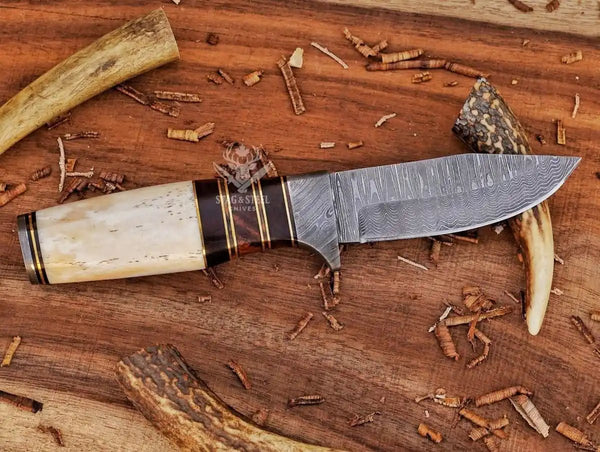


Best Damascus Hunting Knife With Camel Bone Handle
Shipping calculated at checkout
Low stock
Description
Why Is Our Best Damascus Hunting Knife With Camel Bone Handle Suitable for Field Use?
Our Best Damascus Hunting Knife With Camel Bone Handle is a handmade fixed-blade knife created for controlled hunting, skinning, field dressing, and campsite cutting. It combines a 4-inch Damascus steel blade, a 4.75-inch natural camel bone handle, a Damascus guard, and a handmade leather sheath.
The knife measures 8.75 inches overall and weighs 375 g. Its compact blade supports precise cutting, while the fixed-blade construction removes the joints and locking parts found in folding knives.
Hunters and outdoor users can explore more handcrafted blades at Stag Steel Knives.
What Are the Main Specifications of Our Damascus Hunting Knife?
| Product Attribute | Specification |
|---|---|
| Product type | Handmade fixed-blade hunting knife |
| Overall length | 8.75 inches |
| Blade length | 4 inches |
| Handle length | 4.75 inches |
| Blade material | Damascus steel |
| Blade hardness | 58–60 HRC |
| Handle material | Natural camel bone |
| Guard material | Damascus steel |
| Product weight | 375 g |
| Included accessory | Handmade leather sheath |
These specifications define the knife’s intended role. The 4-inch blade supports detailed cutting, the 4.75-inch handle provides a full contact area for the hand, and the leather sheath covers the sharpened edge during carrying.
How Does Our 4-Inch Damascus Blade Support Hunting Tasks?
Our Damascus steel blade has a listed hardness of 58–60 HRC. This hardness range supports edge retention during repeated slicing and trimming when the blade is cleaned, dried, and maintained correctly.
The 4-inch blade is intended for controlled tasks, including:
-
Skinning harvested game
-
Trimming meat and connective tissue
-
Making field-dressing cuts
-
Cutting rope, cord, and packaging
-
Preparing food at a campsite
A shorter blade allows the user to keep the cutting edge close to the working area. This can improve control during skinning and trimming compared with a longer blade intended for heavy chopping.
The knife should not be used for prying, throwing, splitting wood, or striking hard surfaces. These actions can damage the edge or blade.
Readers comparing blade materials can review our guide to the best steel for hunting knives.
Why Does Our Camel Bone Handle Look Different on Every Knife?
Our handle is made from natural camel bone rather than molded plastic or synthetic resin. Natural material can display differences in color, grain, markings, and pattern placement.
Common camel bone variations include:
-
Cream, beige, and darker tones
-
Fine grain lines
-
Natural surface marks
-
Different pattern positions
These variations give each camel bone handle hunting knife an individual appearance. They are natural material characteristics and do not indicate a manufacturing defect.
The 4.75-inch handle creates a defined gripping area behind the Damascus guard. The guard separates the hand position from the cutting edge during normal knife use.
Which Tasks Can Our Small Fixed-Blade Hunting Knife Perform?
Our small fixed-blade hunting knife is designed for precise cutting rather than heavy-impact work. Its main applications include hunting preparation, skinning, campsite food preparation, cord cutting, and light outdoor utility.
Fixed-blade construction means the blade remains permanently positioned inside the handle. This structure has no pivot, locking mechanism, or internal folding channel.
The simpler construction also makes field cleaning easier because blood, dirt, and food residue cannot collect around a folding pivot.
For a broader explanation of blade functions, read our guide covering what hunting knives are used for.
How Does the Handmade Leather Sheath Protect Our Knife?
Our Damascus hunting knife includes a handmade leather sheath. The sheath covers the cutting edge during transport and limits direct contact between the blade and other hunting or camping equipment.
The leather sheath is intended for carrying and short-term protection. It should not hold a wet or dirty knife because leather can retain moisture against the steel.
Before inserting the knife into the sheath:
-
Remove visible dirt and residue.
-
Dry the blade and guard completely.
-
Confirm that the sheath is dry.
-
Apply a light protective oil when required.
For long-term storage, keep the knife in a cool, dry location and inspect the blade regularly for moisture or surface staining.
How Should You Maintain Our Damascus Steel and Camel Bone Handle?
Correct maintenance protects the blade, handle, and sheath from avoidable damage.
Follow these 5 care steps:
-
Clean the blade soon after hunting, food preparation, or campsite use.
-
Use mild soap, warm water, and a soft cloth.
-
Dry every steel surface immediately.
-
Apply a thin layer of knife oil or food-safe mineral oil.
-
Store the knife away from humidity and standing moisture.
Do not soak the camel bone handle. Wipe it with a slightly damp cloth and dry it immediately.
Do not place the knife in a dishwasher. Prolonged water exposure, high temperatures, and strong detergent can affect Damascus steel, natural camel bone, and leather.
Why Should You Choose Our Best Damascus Hunting Knife With Camel Bone Handle?
Choose our Best Damascus Hunting Knife With Camel Bone Handle when you need a compact fixed blade with verified dimensions, natural handle material, and handmade construction.
Its 4-inch Damascus blade, 58–60 HRC hardness, 4.75-inch camel bone handle, Damascus guard, 375 g weight, and leather sheath make it suitable for controlled hunting, skinning, campsite preparation, and light outdoor cutting.
You can compare this knife with other blade profiles and handle materials in our collection of Damascus hunting knives.

